Friday, February 13, 2015

Masters: Old and New

For a film professor the Berlinale is the best crash course on the old and the new, a ten-day field trip through history and current cinema, a full immersion into what, badly paraphrasing J.R.Tolkien, is an ‘enchanted state’.

The Museum für Film und Fernsehen, located in the Sony Center and occupying three floors of  the Filmhaus in Potsdamer Platz, is a stone-throw away from the hub of the festival.  On three floors the Deutsche Kinemathek runs a beautiful and compact facility.  It is comprised of materials coming from its archive – photos, stills, film prints, personal archives – and a plethora of film clips illustrating the history of German cinema, from its inception to today.  It also holds special exhibits, this year, the work of production designer Ken Adam, born in Berlin in 1921, who worked in Kubrick’s 2001 and Barry Lyndon, and in the James Bond films of the 1960s and 70s.

The main section of the museum is organized chronologically, around the big blocks of film history: the development of the technology in the late 1890s, with special attention paid to the Skladanowsky brothers, inventors of an early movie projector in Berlin; the 1920s and the impact of Expressionism; rooms devoted to the key names of the Weimar era (week 4 of the semester!): Ernst Lubitsch, Fritz Lang, F.W.Murnau and Wilhelm Pabst; the film industry under National Socialism; the Hollywood exiles of the 1930s and 40s (the subject of the current Skirball exhibit, though from the angle of film noir), where costumes worn by Marlene Dietrich are a highlight; the two Germanys during the Cold War organized as one section, a study in contrast; and German cinema after the reunification in 1990, with a wall display of posters for each year.  

You can breeze through it in an hour, or spend a long time in each room, going through the film clips, home movies … and taking copious notes of great use in Power Point presentations. All the information is in German, with English translations. A well supplied bookstore in the ground floor sells books, DVDs and BluRays, posters and movie-related tchotchkes.  This visit is an obligatory stop each year, and courtesy of the Berlinale, the entrance is free to accredited guests and journalists.
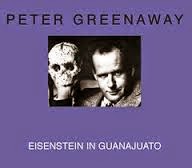


The “old of this entry refer to an encounter with Sergei Eisenstein, courtesy of Peter Greenaway’s latest provocative foray into film and architecture:  Eisenstein in Guanajuato.  I could paraphrase – without the irony – Captain Renault’s line of feigned indignation in Casablanca -  “I’m shocked, shocked, shocked”, but I will quietly note that Greenaway makes a sexual caricature of the great Soviet director.  Fictionalizing from the interstices of Eisenstein’s year-long stay in Mexico in 1930 with his collaborators Eduard Tissé and Grigori Alexandrov, shooting materials for an epic poem on Mexico’s history and people, Greenaway reduces Eisenstein’s artistic experiences to a series of explicit erotic encounters with a professor assigned as his guide.  Diego Rivera and Frida Kahlo, and the Mexican intelligentsia so influenced by this force of nature, are seen on the margins once at the beginning.  And except for some clever split screens, interplay play with color and b&w, and the contrast of real photos of Eisenstein with those of the actor portraying him – the Finnish Elmer Bäck with an uncanny resemblance, especially in the leonine hairdo - there is no hint of the creative storm Mexico spurred in the filmmaker. The argument advanced in the dialogue between the screen Eisenstein and the doe-eyed gentleman object of his desire is that Mexico embodies sex and death as explained by Freud.  Other clichés are attached to this trite view of country and the Mexicans: sombreros, bandoleros, Frida Kahlo-style of hairdos and flowery tunics, skulls and Church processions. 

In competition for Golden and Silver Bears, the film may end up taking something home.  The press conference verged on the bizarre: Greenaway presumed that Eisenstein has been largely forgotten, and so he made the film as a palliative, to bring his contribution to the forefront (not unlike the angle about Alan Turing’s computer work in The Imitation Game).  After many years in the teaching trenches, though, the shrinking of Eisenstein’s enthusiasm for life, art and politics to a very limited view makes this film irrelevant in a history survey class.

For the press, the layout of the Berlinale screenings offers possibilities of chance encounters, and the omnipresent selfies.  I had just spotted Greenaway doing an interview in the lounge of the Palast, when I saw the Eisenstein screen persona Elmer Bäck walk by me on his way to the same event.  We chatted two seconds about his portrayal of the director and he willingly posed for a selfie - mad as I was deep down!


The ‘new’of the title on the other side, is Wim Wenders, the subject of this Berlinale’s homage. Turning 70 in August, with gray hair and tick rimmed glasses, he looked youthful and at ease with the journalist attending the press conference. He discussed the importance of film preservation, the promotion of new talent, and his teaching activities, discussing the retrospective of his work at this year’s Berlinale.  Asked about the future of his own work, he noted that the creation of the Wim Wenders Foundation had made this non-profit organization the copyright holder of his films, facilitating fund-raising and restoration. Designed like the Murnau Stiftung and the Fassbender Foundation, this organism is the best way devised so far to preserve cinema, along the line of what the World Cinema Foundation, founded by Martin Scorsese and of whose advisory board he is a member. 

It may look from this account as if the press conference was a dry affair about numbers and the fear of cinematic destruction, but far from it.  Wenders recalled fondly his love of bicycling in Berlin, to see the changes of the city, to which he so movingly paid homage in the magnificently titled Der Himmel über Berlin (Wings of Desire, 1987), and Faraway, So Close! (1993). He talked about the comedy he dreams of making, and he never will, and about the excitement of shooting in 3D which has broadened the “emotional scope of film”. He is still very much interested in the possibilities of language and communication, as he was in the film that made his career Alice in the Cities (1974).  I would like to argue that his latest work, the gentle drama Every Thing Will Be Fine shown outside of competition, still revolves around how a person can come out of an emotional anesthesia emerging from geographical deserts, like Harry Dean Stanton in Paris, Texas (1984), spiritual isolation or moral inertia to live a full life in contact with the others.


The Berlinale is over tonight, when the international jury headed by Darren Aronofsky announces the Golden and Silver Bears.  I will perhaps leave the city tomorrow – the storms in the East Coast have disrupted flights as far away as Berlin – carrying a suitcase full of papers, and many new films and ideas in my head.

Tuesday, February 10, 2015

Two documentaries at the 2015 Berlinale: the personal and the political are inseparable

I have seen two excellent documentaries at this Berlinale, a testimony to the unbound possibilities of the genre: Walter Salles’ Jia Zhang-Ke, a Guy from Fenyang; and Iraqi Odyssey, directed by Samir (no last name given in the festival catalogue, or when the director introduced the film).  I could spend a whole semester dissecting the flexibility of the medium using only these two very different approaches to ‘the creative treatment of actuality’, to quote John Grierson, the indispensable reference.

Walter Salles, whose international recognition began in Berlin in 1998, with the Golden Bear to Central Station, met Jia Zhang-Ke precisely at this Berlinale, when the Chinese filmmaker, a graduate from the Beijing Film Academy, showed his first feature film Pick Pocket (1997).  Their friendship and love of cinema has crystallized in this remarkable collaboration, whose seeds originated at the Mostra de Sao Paulo in 2007, with a Jia Zhang-Ke retrospective. 

Explaining that Jia Zhang-Ke was shooting his next project, Salles introduced the documentary and had a warm Q&A with the audience in the packed Cinestar 7, in the Sony Center at Potsdamer Platz. And for the next 105 minutes, the public was treated to a very traditional documentary format – expository, no stylistic flourishes or voiceover narrator – made extraordinary by the quiet, unprepossessing personality of the Chinese director and film clips from a remarkable body of work – Platform (200), Still Life (2006) and A Touch of Sin (2013) – portraits about the ‘non-holders of power in a time of confused values and national malaise’, as Jia Zhang-Ke notes.  


The idea behind the film is to see how the director’s memories and experiences of growing up in Fenyang, a town in Shanxi province, northern China, shaped his films.  Salles follows the filmmaker through courtyard apartments and busy streets in this shabby town, talking to family and friends, and superimposes scenes of the films shot on those locations.  By remembering the minutia of life in remote from the centers of power on the coast, Jia paints the turmoil of China’s last forty years – from the Cultural Revolution and its horrific toll, to party capitalism, globalization and their cost – from the perspective of ordinary folks.  The voice of the director talking to the camera and over his films not only document China’s crisis of culture and clash of values – like his cinema - but is also a celebration of his, and Salles, passion for cinema.  The gift of this documentary is to make us travelers to China and come closer to understand how in the hands of gifted filmmakers the local can reveal the universal.

A family’s trove of home movies will remain just that – records of people’s special moments in their lives – unless they can transcend its ‘home-movieness’ thanks to the artistic touch of the director.  Which is what happens in the supremely entertaining three-hour long Iraqi Odyssey.  An example of the first person documentary – à la Michael Moore, Ross McElwee and Alan Berliner, to cite US directors – Iraqi Odyssey combines a wealth of home movies, photos, interviews with family members scattered all over the world, animated maps and archival footage, under the first person account provided humorously by Samir, its Iraq-born Swiss director.  This subjective approach gives a great flavor to the film because it is grounded in a specific perspective, that of the upper class professional bourgeoisie in Iraq, a narrative not commonly heard in the media.  The story of this multi generation family spans from the Ottoman Empire, the partition of the Middle East after WWI, the impact of WWII, the takeover by the Baath Party in the 1950s, the Sadam Hussein dictatorship and the US intervention in Iraq.  No stones are left unturned in this chronicle of a highly articulate family in the diaspora who enjoy a rendez-vous in Switzerland in the climax of the film.  And as one of the patriarchs says at the end, Samir’s family is, on a small scale, an example of how multiple cultures, religions and languages can coexist. 

I wish the emerging filmmakers in my documentary class could see Iraqi Odyssey: it would help them see that by putting together their family history they can capture the larger threads of history.   The director and many in his family made the trip to Berlin to talk about their adventuresome lives in Iraq, Lebanon, Egypt, Libya, the Arab Emirates, Switzerland and the US, while the Iraqi and Swiss ambassadors to Germany were called to the stage before the packed screening as a gesture of good will.

With great interest I also saw the latest films of Wim Wenders and Werner Herzog, titans of the New German Cinema of the late 60s/early 70s, still active filmmakers, but maybe with their best work behind:  the small scale drama Everything Will Be Fine and the period biopic Queen of the Desert.  James Franco is the protagonist of the first one and has a supporting role in the other.  The press has skewered them.  You have to be tough in this business of filmmaking.

Introducing Franco after the premier of Everything Will Be Fine, Wenders called him 'Mr Berlinale 2015'. Besides these two films, Franco stars in I Am Michael, directed by Justin Kelly, shown in the Panorama section of the festival.


Saturday, February 7, 2015

Berlinale 2015: The long take, technique du jour.

Two films burst into the Berlinale competition like gunslingers shooting from the hip: Jafar Panahi’s Taxi, a seriously comical view about filmmaking in Iran today, and Victoria, a riveting long-take tour-de-force crime film set in Berlin, directed by Sebastian Schipper.

Panahi was banned from making films in Iran by its Islamic regime after Offside (2006), his cinema vérité style X-ray of Iranian social affairs played at the Berlinale  – and a staple of my international cinema course at UCLA. The festival – true to its historical mission of supporting beleaguered filmmakers around the world – invited him to be a juror in 2011, but the director was pressured by the Iranian authorities to decline it.  Two years ago the Berlinale showed Closed Curtain, a companion piece to his documentary This Is Not a Film (2011), playing in Cannes. These two films interrogate the act of filmmaking by a director who is courageous and clever, and is staying in Iran.  What negotiations have taken place between the Ministry of Islamic Guidance, the powers minding the cinematic foreign affairs of Iran, like the Farabi Foundation, and this director that stubbornly works on a self-reflexive vein, we do not know.  But the films are here to make the international audience – and particular our film students – ask questions about the role of cinema, and the place of the filmmakers in a restricted society, one with ‘movable’ walls between the public and the private spheres, as Hooman Majd explored in The Ayatollah Begs to Differ (2009).

The press screening of Taxi on the second day of the festival won the critics over from the start: the point-of-view shot of a camera set on a pivot inside a taxi, waiting for a green light in a busy intersection.  Built on a series of unhurried long takes, the camera tells the story by panning on the various characters that come in and out of the car, whose driver is  … the director himself. He is  acknowledged as such by the assorted mix of characters, young and old, educated or simple, whose conversations and interactions give us an update on what was discussed in the previous films.  Taxi is the comedy of this trilogy, and so tragicomically funny all the way to the last shot, that you come out of the film laughing with, not at, the predicament of the director and his characters.  It is a tightly woven piece of writing and acting, complete with in-your-face references to what it takes to make a ‘distributable’ film in Iran – recited hilariously by the ‘niece’ of the director; the lure of American pop culture; and the power of images – especially from iPhones! – to shape the conversation on cultural and political matters.  Some characters are unforgettable, like the pious old ladies who have to reach a spring by noon to throw the fish they are carrying with them so that they will not die; the misshapen fellow that makes a living distributing illegal downloads; the sassy niece with a film school project; the elegant lady lawyer defending political prisoners.   The film ends where it began, à la Man with the Movie Camera with the camera taking a bow, only this time the ‘mechanical eye’ – invisible but palpable - is ripped off from its pivot by unknown minions, so what we abruptly see at the end is a black screen.  Taxi is also a wink to Ten (2002), by Abbas Kiarostami, one of the other great Iranian filmmakers, now living in Paris, who makes a taxi cabin a metaphorical place to talk about the same things Panahi explicitly does.


Written and directed by Sebastian Schipper, born in Hanover in 1968 and initially trained as an actor, Victoria is an exhilarating piece of filmmaking.  The analogy I could think of was Tom Tykwer’s Run, Lola, Run (1998), which I first saw in the Berlinale and has also become a staple of my film esthetics classes.  The conceit here is to show a wildly dramatic event, in a few hours – from night to dawn – through what seems one hand-held long take.  (A second viewing is of the essence, to track how it was done).  What’s different from Gravity (2014) and Birdman (2015) is the shifting tone of the film, and the clever playing with genre conventions, moods and ultimately, plain old-fashioned suspense.  ‘Riveting’ is an understatement to describe the emotional twists and jolts of a strobe-lights beginning in a night club in Berlin to a climatic ending, where the real time of the long take allows us to physically ‘see’ how a final decision is made.  Victoria is the name of the non-German speaking young Spanish woman (terrific performance by vivacious Laia Costa) who gets involved outside of the disco with a bunch of hooligans – textbook case of beware of the big bad wolf – and goes for it when things take an unexpected turn – the daring side of the Spanish psyche.  Part of the film’s horrified delight is to see how the narrative machinery begins to slide into a full crime film, after a romantic interlude of sorts, complete with an unexpected twist two-thirds into the film.  The camera work by Sturla Bradth Grovlen will certainly fascinate more than my cinematography students.  Sebastian Schipper is like a German Quentin Tarantino, with a sharp ear for dialogue and a clever way of reworking cinematic conventions. Watch out for the splash this Victoria of innocuous title is bound to make

Tuesday, November 11, 2014

Polish documentaries in Los Angeles

Last September I received a lovely invitation to review the documentary submissions to the 15th Polish Film Festival in Los Angeles, held for a week in October.   It was a group of solid films, funded by a variety of public state and regional organizations, such as Polish Television, the National Audiovisual Institute, including other Polish and European funds.  These documentaries show the healthy state of documentary filmmaking, made possible by programs promoting quality, and relying on a rich tradition of cultivating documentary cinema.  I am very thankful to Vladek Juszkiewicz, the founder and director of the festival, for this opportunity to savor the moving humanism of Polish cinema. (My first film viewing experiences in Buenos Aires in the seventies were deeply shaped by the films of Wajda and Zanussi).

As John Grierson, the father of documentary, observed many years ago, good documentaries both educate and entertain. And I found that to be the case of the films I had the pleasure to review.

Children Calling is an observational piece on a helpline for children and teenagers, staffed with sympathetic listeners, who provide common sense but not professional advice.  It is done in a strict verité style, with an emphasis on close-ups and extreme close-ups of the young women answering the phones.  The viewer hears snippets of life stories  – some quite dramatic – over a year. The passing of seasons is nicely recorded, and adequately conveys the flow of time. The film is framed by shots of home-made toys, and at regular intervals, the antics of a dog.
   The 30 minute-length matches adequately the scope of the film: to catch without any editorial comment, voice-over or preliminary text, the everyday activities of a small institution, peopled by caring individuals.  The joys and limitations of the cinéma vérité style are well exemplified in this professionally executed short film.

Albert Cinema (2013) by Agniezka Zwiefka, also chooses a mostly cinéma verité approach to tackle its subject matter: to record the making of an amateur film by a motley group of homeless men living in a shelter. 
   Eschewing a narrator or any explanation about these characters, except for what they reveal to the camera, the film slowly builds a very moving portrait of broken lives held together by dreams and hopes.  The protagonist of this group effort is a rugged man, a former alcoholic hippie, eloquent in front of an unflinching camera/confessional, who finds redemption and a renewed relationship with his estranged son, after premiering the film.
   There is a nice fit between the length of the film (to fit an hour-long television slot) and the leisurely pace in which the story unfolds, expertly edited to build a climax and a resolution.

In A Diary of a Journey (2013), directed by Piotr Stasik, cinéma vérité is again the style of choice to record the summer-long journey through the Polish countryside of a classically trained photographer, now in his seventies, who takes a young high-school student as his apprentice. 
   The charm of this documentary is two-fold: the geographical journey in search of interesting faces, seeped in the everyday of rural life, and also the mentoring process involving an old artist with an adventuresome life and a young man getting ready to live. 
   Like Children Calling and Albert Cinema, there is no narrator explaining the context or who these characters are – just a few shots of 1960s fashion photographs introduce the older professional as an established figure – and what pushes them to take this trip.  The beauty of the rural landscape is lovingly captured, as are the tough and warm inhabitants of the small places they visit.
   A portrait of the artist as an old man and a record of a satisfying artistic experience, A Diary of a Journey is skillfully edited to make the mundane details of traveling an exhilarating experience (a fender-bender, a swim, cooking), culminating in a moving revelation of a man assessing his life when most of it has already been lived.

Joanna (2013), director by Aneta Kopacz, is another remarkable observational portrait, in this case that of a young mother and wife dying of cancer.  Doing it in a strict verité style was a bold choice, one that both benefited the narrative structure and facilitated the non-intrusive relationship between the camera and the titular protagonist. It also avoided the pitfalls of melodrama in the building of a story that ends in death and sorrow.
   In a feat of editing bravura, Joanna ends up being a contemplative take on youth and death, motherhood and marriage, love, nature and the tangible world.  Tweaking the chronology and trusting the viewer to figure out the emotional direction of the story, Joanna culminates in a celebration of love conquering death, by showing the protagonist’s young son learning to ride his bike with the help of his mother.  The humanity of the portrait, movingly built over the 50 minutes of a television slot, is accomplished with grace and technical skill.
   (It shouldn’t come as a surprise that this notable documentary was produced by the Wajda Studio).

A Dream of Warsaw (2014), direted by Krzysztof Magowski, is an accomplished example of the modern music documentary, like the ones pioneered by Martin Scorsese (Shine a Light, No Direction Home). If it must be fascinating for a Polish audience to see the multilayered relationship between a well-known rock singer and his times – the 60s to the 90s – unfold through archival materials and interviews, much more so to an international audience who is not familiar with the iconic figure of Czeslaw Niemen.  What bursts on the screen is the view of a parallel world, one behind the Iron Curtain until the collapse of Communism
, with a musical figure as iconic as the Beatles and the Rolling Stones, tangled up with politics since his beginnings as the popular singer who became the king of Polish rock


Thoroughly researched and skillfully edited, with talking heads, including family members and pop music experts serving as de facto narrators, this documentary is a solid example of the classic expository approach: the thorough examination of a topic.  Just the archival work to dig photos, newsreels, publicity materials, interviews, film clips and a verité documentary about Niemen, not just in Poland but in Europe and the US, makes this a worthy piece of filmmaking.
   Like Citizen Kane, the documentary is built around a question: Who was Czeslaw Niemen?  Through multiple perspectives, the viewer is treated to an examination of the  many facets displayed by the singer/composer over a long career, spanning crucial decades of Polish history and politics.  It makes for a fascinating portrait, where the threads of the private and the public, the personal and the political are inextricably woven. 
 
Cabaret of Death (2014), directd by Andrzej Celinski, is a multi-layered film dealing with a straightforward subject: the cabaret acts staged by German and Polish Jewish performers in the Warsaw ghetto and concentration camps during WWII.  It has been the topic of various documentaries, most effectively Ilona Ziok’s Kurt Gerron’s Karussell (1999) about the Weimar era German actor and director imprisoned in Therensienstadt.

  Walking on a well-trodden path, this feature length documentary stakes, however, a bold claim in a territory often dismissed by purists of the genre: reenactments of anecdotes and commentaries offered by witnesses and experts, who vividly illustrate the difficulties, perils and joys of staging theatrical sketches in extreme situations. But unlike the titillating self-contained formula perfected by the History Channel, the film keeps the various dramatizations at the service of what I believe is the film’s ultimate objective: a historical essay about the persistence of a cultural legacy in the face of ethnic catastrophe. By bookending the loosely connected stories of these cabaret performers – including Gerron’s - with the graceful opening shot of a holy fool (I wish I knew the Yiddish word) on the slabs of the Shoah memorial in Berlin and his final appearance walking through a verdant Jewish cemetery, Cabaret of Death goes beyond the expository approach to become a work of mourning.  In that sense, I also believe, it becomes part of the difficult conversation among Poles of different traditions – like the recent Ida so intelligently does as a fiction film.
   Cabaret of death is not only an excellent contribution to the historical documentary but also a solid example of how film technique can be used to teach and entertain. 

These fine works attest to the variety and quality of a film genre that matters to cultural organizations in Poland, thus ensuring the healthy state of a type of cinema born with the invention of the Lumière’s cinématographe.

The best documentary award of this 15th edition went to A Diary of Journey, with its young director Pitr Stasik on hand to receive the prize during the gala opening of the festival at the Egyptian Theatre in Hollywood.