Saturday, April 20, 2013

At 25, Luis Valdez' "La Bamba" resonates differently ...

The following are the program notes I wrote for the screening of La Bamba, organized by the Latin American Cinemateca.  It is part of the Los Angeles Conservancy series "Last Remaining Seats", to unfold next June in historic downtown theaters.

With his second film La Bamba, Chicano playwright and political activist Luis Valdez went after mainstream American audiences to tell the story of an almost forgotten Mexican-American rock-and-roll star, Ritchie Valens. It was an overwhelming, unexpected box office hit.  Made for under $10 million, it grossed $60 in the US.  In the late 1980s, its success coupled with that of Stand and Deliver and Born in East L.A. seemed to augur a renaissance of Hispanic-themed films.

On the strength of Zoot Suit, first a play and then a 1981 film, Luis Valdez and his brother Daniel as associate producer brought the project to Columbia Pictures and Taylor Hackford, who produced the picture for a modest $6 million, with a then unknown Lou Diamond Phillips in the lead role.
With close cooperation from his family, the film tells the story of Ricardo Valenzuela, the teenage rock-and-roll sensation, who in less than a year and still in high school, recorded three songs – two original, one a rock version of a Mexican folk song – that became top ten hits in 1958: “Come on, let’s go”, “Donna” and “La Bamba”.

Renamed Ritchi Valens by record producer Bob Keane, Valenzuela is the sweet tempered, straight-arrow protagonist of this rag-to-riches story, emblematic both of the American Dream and the struggles to jump into the melting pot.   His life was tragically cut short at age 17 in February 1959, by a plane accident that also killed other young rock sensations Buddy Holly and J.P. Richardson, “Big Bopper”.
La Bamba is both a rock-and-roll picture and family drama, tightly centered on the efforts of Connie Valenzuela, a young widowed matriarch (Rosana de Soto), to promote the strong musical talent of her second son.  She, her other son, the rebellious Bob (Esai Morales), and two young daughters portray a recognizable Mexican American family from Pacoima, in the San Fernando Valley.  Shot on location in Los Angeles and the Central Valley – where the Valenzuelas are first seen working as orange pickers – La Bamba looks affectionately at the struggles of a family in postwar Los Angeles to carve a piece of the American Dream.

The film’s somber side is provided by older brother Bob, almost a caricature of Hispanic machismo, and an ambivalent carrier of Chicano pride, headed in the wrong direction.  This competitive relationship provides a dramatic counterpoint to the blandness of the story: eight months in a clean-cut teenager’s life. 
  The East L.A. phenomenal group Los Lobos was enlisted for the musical numbers, with member David Hidalgo standing for Valens.  Their four songs for the soundtrack were released in an album that sold a record 2 million copies and spent 3 weeks at number one on the pop charts, as reported by Los Angeles Times music critic in September 1990.
The musical numbers are exhilarating, especially its electrifying rendition of the joyful “La Bamba”, originally a song from Veracruz, in the Gulf of Mexico.

Twenty-five years after its original release, La Bamba lends itself to an interesting re-evaluation.  Viewed today, the film has lost none of its freshness and the genuine emotions it evokes in mainstream audiences.  It has acquired, however, a patina of nostalgia tinted with a somewhat rosy view of working class life in the 1950s.  The conventional aspects of the picture have become more salient: a by-the-numbers, carefully crafted biopic about a non-rebellious teenager with a musical cause.  The Mexican-American aspects are rooted on features that have become standard in film and television when Hispanic types are involved: strong matriarchs, males unhinged by drugs and anger, suffering but passionate females, resilient family bonds.
The character of volatile brother Bob allows for a remark on the evolution of Chicanismo, a passionate political and cultural cause three decades ago, when Valdez wrote Zoot Suit for the theatre and began to conceive of the Valens film with his brother.  Now practically reduced to an academic specialty in the American university, Chicanismo is carried in La Bamba by the Esai Morales character, incarnating – in the words of Dr. Rosa Linda Fregoso – “the revolutionary subject of cultural nationalism”.  A 1980s version of the ‘pachuco’ – flashy clothing, the motorcycle a muscular extension of unbridled, unfocused energy – Bob is passionately attached to the mythical pre-Hispanic roots of Chicanismo, as personified by the ‘curandero’ he and Ritchie visit in Tijuana.  Seen twenty-five years later, what Bob perhaps represents is the identity crisis of the Chicano who makes a stand against assimilation … and cannot partake of the American Dream his brother began to savor, albeit briefly. 

The current musical reemergence of 1970s singer Sixto Rodríguez, described as the “Chicano Bob Dylan”, thanks to the Academy Award winning documentary Searching for Sugar Man (2012), also invites some intriguing analogies.  Valens and Rodríguez – the son of a Mexican worker who immigrated to Detroit – are both emblematic of their times:  the former embodies the breath of fresh air brought by rock-and-roll in the fifties, a truly American style born of mixing popular musical styles.  Rodríguez is fully immersed in the counterculture of the sixties and seventies, a poetic walking scream for the dispossessed and the broken-hearted.  Their music and lyrics are also representative of the singers’ working-class background – which comes out with pride in La Bamba and the bonus materials of the DVD release, and the Rodríguez documentary. Both create their memorable songs from a position of American-ness, not Other-ness.  They bring spice to the melting pot, but are fully immersed in it.
La Bamba will offer the younger audience the opportunity to get acquainted with some great pop music. Courtesy of the digital revolution, they will have an incentive to explore very easily the rock-and-roll world to which Ritchie Valens made a remarkable contribution.

Filmography – Luis Valdez

The Cisco Kid (1994)
La Pastorela (1991)
Corridos: Tales of Passion and Revolution (1987)
Zoot Suit (1981)

BibliographyLa Bamba

Fregoso, Rosa Linda, The Bronze Screen – Chicana and Chicano Film Culture, 1993.
Hillburn, Robert, “Blame it on La Bamba”,  Los Angeles Times, 2 September 1990.

“La Bamba opens the door for Latino films”, Los Angeles Times, 4 April 1988.
Lasley, Paul; Harryman, Elizabeth, “La Bamba director sees Hispanic culture joining mainstream”, The Christian Science Monitor, 14 September 1987.

Maslin, Janet, “Brief Candle: La Bamba, a musical biography”, New York Times, 24 July 1987.
Los Angeles Times, 13 August 1987
Mathews, Jack, “La Bamba: Lyp-synced for success”,

Van Gelder, Lawrence, “The Birth of La Bamba”, New York Times, 24 July 1987.


Saturday, February 16, 2013

Not Borat's Kazakhstan - Harmony Lessons and other films in the Berlinale


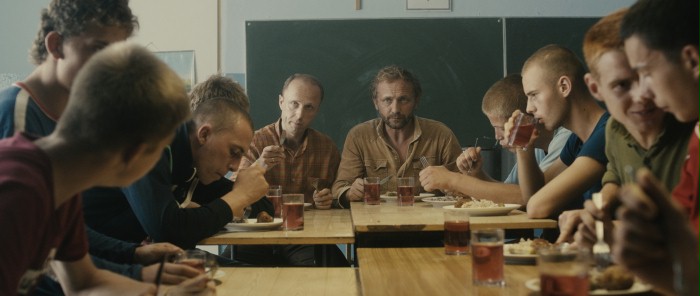
What is so remarkable about Harmony Lessons, the Kazakh entry in the competition, is its maturity of form and astute handling of content.  The team behind it - writer/director Emir Baigazin, producer and cinematographer - is under 30, and its young teenagers in high school. 

Set in a small provincial town at the edge of the steppe, the story unfolds meticulously around a quiet kid, bullied at school by a fiendish gang, into which is planted the idea to kill.  His face a cipher, the motive behind the brutal experiments with bugs is survival.  The slaughtering of a sheep in the opening sequence, shot in observational documentary style, is a clever capsule of what is to come, and the psychological explanation of the kid’s obsession with cleanliness and control.  The audience’s sympathy never once leaves the boy.  Tightly controlling the mise-en-scène, with long takes, sparse framing and a naturalistic sound design, the film elides two carefully anticipated scenes in order to thrust the narrative into a metaphorical ending, made all the more powerful by its handling of emotions – the characters’ and ours.  Harmony Lessons depicts a faraway world made familiar by tapping on recognizable human experiences – the pains of  growing up - while draining the geographical environment of any distracting local color.  I’d love to see the film recognized by the Berlinale’s Bauer prize to emerging directors.

Another intriguing use of genre and plot is the deceptively simple Neorealist drama An Episode in the Life on an Iron Picker, a film from Bosnia, shot in five days by Danis Tanovic with a skeletal crew on a budget of 17,000 euros.  Based on an incident read in a newspaper, the film is the reenactment of a dramatic episode: a Roma family, barely making ends meet in the countryside, is forced to scrape its battered car into iron and sell its parts to pay for the pregnant mother’s surgery. 

The film begs a central question: Is it a documentary, like Nanook of the North, with the filmmaker a present-day Flaherty observing the will to survive in a harsh environment – punctuated almost poetically by recurring shots of a nuclear power plant?  Or are we dealing with the fictionalized scenario of Bicycle Thieves, an update of the unsolvable moral conundrum of people outside of the economic system?   An Episode in the Life of an Iron Picker cleverly poses the issue in a way that incorporates simultaneously these mutually exclusive answers.

The gypsy couple came to the Berlinale – a study in glamour contrast and red carpets - and recounted their plight to the journalists attending the press conference.  It was a stunning experience, as if one had the chance to see Lamberto Maggiorana and family agonize again over their stolen bicycle.

Another intriguing narrative experiment was seen out of competition , Bad Blood, by the Dutch filmmaker George Sluizer.  He put together and scored the unedited footage of the project he directing when River Phoenix died suddenly in 1993.  A thriller set in the Southwest against a background of Hopi mytholohy, principal photography was three fourth done, with some key scenes still to be shot.  The film follows a Hollywood couple (Jonathan Pryce and Judie Davis) stranded in what looks like Capitol Reef in Utah, slowing falling in the hands of a disturbed angelic-looking young man of partial Indian ancestry, the then-23-year-old Phoenix with raven hair and sharply delineated features.

Not unlike Eisenstein’s unfinished Que Viva Mexico, a device outside of the diegesis gives the picture structure and meaning – in this case the director narrates the missing parts and plugs the plot gaps.  What emerges is not a remarkable film, perhaps not even a good one, but a two-fold experiment bound to satisfy the viewer looking for something different.  On the one hand, it is a horror story pitting reason and science against Indian mysticism (interestingly, the slant is far from PC).  On the other Dark Blood embodies the romantic European view of the American West – vast, majestic, dangerous –  the way Werner Herzog has shown it in Grizzly Man.  However, the logic of the box-office dictated that Sluizer followed the tropes of the horror genre and its Hitchcockian ending.  Ironically, Dark Blood became the opposite of what it was born to be:  it is a modernist work that comments on itself.  We can see why it found a slot in the Berlinale …

Tuesday, February 12, 2013

Jafar Panahi: To be or not to be in Berlin


The Berlinale has steadfastly taken up the cause of this Iranian filmmaker banned by the clerical regime of his country from making film for twenty years.  In 2011 Cannes showed his video diary This Is Not a Film, and yesterday the competition screened his remarkable piece of reflexive filmmaking Closed Curtain.  Panahi’s  2006 Offside, a clever comment of the status of women in Iran, shot in the guise of a documentary, had started his troubles; one cannot help but wonder what this intriguing piece –a plea of sorts to the Iranian authorities – will do to him and his collaborators in the project.
The first part of Closed Curtain works as not very subtle metaphor for his confinement – it begins with an extremely long take of a metallic curtain, seen from inside of a house by the sea.  It concerns a writer (Kamboziya Partovi, credited also as co-director), hiding his dog from extermination while receiving the unexpected visit of two fleeing siblings from a certain but mysterious danger.  Before the allegory becomes too trite, there is an unexpected narrative twist: Panahi enters the story as himself, directing a three-person crew behind the camera.  He takes over the role of the writer, while retracing his same steps and engaging in the ordinariness of daily life.  What came into sharp focus then was the ambitious nature of Closed Curtain: it is Panahi’s 8 ½, a film that reflects both the personal and creative crisis of the director, making the form of the work imitate its content. 

This is the beauty and limitation of Closed Curtain: not just a film that telegraphs its intentions  to the sympathetic audiences at the Berlinale (how can it ever be shown in Iran?) but also a gallant attempt to shape its form to express artistic repression.  It also reflects the price the director pays in a world of closed doors.
When this modernist strategy became evident, I could not help but think that the beautiful Maryam Moghadam is an Iranian rendition of Claudia Cardinale’s muse in 8 ½.  With a pinch of Pirandello thrown in the mix.

The co-director and actress came to Berlin.  As was to be expected, they were guarded and gave well-rehearsed answers to the obvious questions. 


Outside of the Berlinale Palace, a small group of human rights activists reminded those passing by, including television crews, what is at stake.   


In sharp focus: the films of the 63 Berlinale

The ten days of the Berlinale - this year from February 7 to 17, 2013 - are the best crash course on new works and industry trends as well as a lovely revisit of film history.  For a film professor, a gift to look forward to the rest of the year.

 Below are capsules of some of the films in the Official Competition.
 Wong Kar Wai's The Grandmaster opened the Berlinale, with the direcctor as president of the jury.  Four years in the making, this kung fu biopic tells the story of Yip Man, the martial arts teacher of Bruce Lee in Hong Kong.  It is baroque unleashed  with slow motion fury - the style and emotions of Wong Kar Wai's films strained to a curlicue.  The tumultuous history of China from the twenties to the seventies is an opulent canvas where the filmmaker and his French cinematographer embroider a series of set pieces, suffused in romanticism and nostalgia. The freshness and whimsical narrative of Chungking Express - always a hit with the students - is replaced by a highly stylized visual and sound design, dynamically punctured by split-second shots of kungfu fights captured from impossible angles. 

 The Grandmaster is a delight to watch, more candy than substance, ultimately (as per the flmmaker's comments in the press conference) a celebration of a Chinese culture.  A case, it seems to me, of  "when the legend becomes fact, print the legend  ..."
The Polish drama In the Name of ... by Malgoska Szumowska carefully builds the crisis of conscience and identity of a Catholic priest. His first sermon relays what seems will be the the core of his pastoral care among youth at risk, "there is a spark of holiness in each one".  Intriguing to me for its initial implications about broken humanity in a documentary-style shoot in rural Poland, the film becomes a study of homosexual tendencies finding an outlet.  The portrait of a good man wrestling with his demons avoids open denunciation of Church tradition as well as sensationalism;  its perspective, however, is unmistakable, made clear in the First Communion procession, shot with a hand-held camera to the effectively incongruous lyrics of the pop song "Some broken hearts never mend".  

The film is most effective in combining a seemingly improvised style dictated by the needs of location shooting with a sophisticated mise-en-scene that shows the priest as a Christ-like figure, complete with sacrificial lamb touches.  It is a finely textured portrait of  "la noche oscura del alma" , the dark night of the soul, so eloquently described by San Juan de la Cruz, but unlike Bresson's Diary of a Country Priest it won't take you to the  "tout est grace" of the ending ... just an image of the priest shot as a Caravaggio scorzo of a dead Christ.

In  Promised Land, directed by Gus Van Sant, and produced by Matt Damon, also co-writer and star of the film, we have Frank Capra revisited with a twist.  Damon begins as an Edward Arnold villain and ends up like Jimmy Stewart, complete with a public confession scene in front of the little people - in this case a small community that may become Pottersville if they give in to corporate greed and "fracking".  It was fun to see the still potent effect of the Capra narrative. 
 The Berliners went of course crazy with Matt Damon, who announced would be back in town shortly to begin shooting a film directed by George Clooney. His infectious smile won over even the most-hardened critics of this sweetly old-fashioned film.

 The contrast could not have been more brutal between this optimistic picture and the mordant take on humanity in Austrian enfant terrible Ulrich Seidl, Paradise: Hope.  The third installment of a trilogy  turning the three theological virtues upside down, the film takes place in a camp for obese teenagers.  In this savage critique of a physical concept of beauty, one can understand not only Freud in Austria, but also how alive Bunuel's surrealism is today.
 
The Romanian entry Child's Pose explores the Freudian territory of the repressive mother in a gripping story set in present day Bucharest, among the new elite of the post-Soviet era. There are knockout performances in a tightly written screenplay that weaves the moral implications of involuntary manslaughter with a nuanced description of a maternal instinct unleashed on a grown up son.


The German Western Gold was the most fun to watch for his  fan of the Western.  The story of a group of German immigrants lured to the Klondike for gold, is half Karl May's romantic infatuation with the American West and half Robert Altmann and Arthur Penn.  But  director Thomas Arslan really wants to be  ... Budd Boetticher, as per the press conference.   Like Meek's Cutoff , the most recent encarnation of the anti-Western, Gold favors characters  (but mercifully no mumblecore)  at the expense of action and story.  The vast expanses of British Columbia do the trick in conveying the harshness of the elements against which the beauty and pluck of the luminous Nina Hoss stand out.
Denis Diderot's rabidly anticlerical novel" La Religieuse" trades its political critique for a sexual update down a foreseeable path - convents breed you know what.   It keeps its anti-Church slant intact, becoming too explicit for its own good.  It was screened on Sunday. 

 Films about relationships find themselves with a good slot int he Berlinale. Such is the case of Before Midnight, Richard Linklater's third installment in the fictionalized portrait of a Franco-American couple (Ethan Hawkes and Julie Delpy, who also co-wrote the story), now forty-somethings facing parenthood and assorted obligations, who cannot stop whining.  Lightweight with some insights into life, couples and conflicting desires, this Woody-Allen wannabe is nicely shot on location in Greece, using long takes and credible but mostly pedestrian dialogue.  Truffaut's Antoine Doinel series comes to mind, except that the French cultivation of "le bon mot" is not part of the package. 
Steven Soderbergh's Side Effects is built on time-honored Hitckcock strategies: the innocent man wrongly accused, plot twists and turns, and the changing of the spectator's alliances. It disappoints, however, since its moral logic is severely diluted by turning a story of pharmaceutical greed into a lover's spurn.

 Finally, the post-Tarantino effect is alive and well in  The Necessary Death of Charlie Countryman, by Swedish commercials director Fredrik Bond, starring Shia LaBeouf and Evan Rachel Wood, with Danish Mads Mikkelsen a super meanie.  Mixing MTV techniques with a surrealist approach to storytelling, this dishevelled  Run Lola Run set in Bucharest is so lightweight that one wonders about its selection for the competition.


Monday, June 18, 2012

Subversive humor: Cantinflas musketeer


On Wednesday, June 20, 2012, at 8pm, the Latin American Cinemateca of Los Angeles  will screen       Los Tres Mosqueteros (The Three Musketeers, 1942), directed by Miguel M. Delgado, with Cantinflas  (139 minutes).  As part of the L.A. Conservancy series "Last Remaining Seats", the film will be shown at the magnificently restored Million Dollar Theatre in downtown Los Angeles.

Below are the program notes I wrote for the event.

Los Tres Mosqueteros spoofs the beloved historical novel by Alexander Dumas.  Comic legend Mario Moreno, “Cantinflas”, stars as the street savvy Mexican proletarian emerging in a dream as the dashing d’Artagnan in17th century France. 

Like Germán Valdez, “Tin Tan”, and Niní Marshall, “Catita”, Mario Moreno “Cantinflas” belongs to the pantheon of great Latin American comedians of the forties and fifties who brought a unique comic persona to the screen.  Their humor blends slapstick and linguistic mannerisms, thrives on parody and excels in the sharp portrait of popular characters.  They use film as a vehicle for amiable social satire, a mirror that reflects shared national traits, anchored in the perspective of the common people.

Born in the working-class neighborhood of Tepito, Mexico City, in 1911, Mario Moreno honed his comic persona performing in ‘carpa’, or tent, vaudeville shows. He combined physical comedy with a knack for verbal improvisation, and a studied nonchalance when his sentimentalized low-life characters had to face the powerful, the rich, the bureaucrats.

Mario Moreno once defined “Cantinflas” as ‘the prototype of the humble people from the urban barrio … superficially educated and practically non-existent socially, but with a highly developed ingenuity (a Mexican characteristic), a formidable astuteness – and a large and open heart”.  In fifty films over forty years Moreno offers variations on this prototype: the little man who is perennially broke, a ‘pelado’ (literally, without hair, stripped clean) pushed by poverty to be a jack-of-all-trades, resilient and witty facing the catastrophes of life. His pants hang off his hips, he sports a pencil-thin moustache, a raggedy hat and has no sense of style.

A trademark of “Cantinflas” is his unique type of nonsense speech, mixing double-talk, alliterations, malapropisms, highfalutin affectation and pantomime delivered at breakneck speed and incomprehensible.  The Real Academia Española de la Lengua incorporated “cantinflada” as a noun in its venerable dictionary.

Intellectuals and academic have examined the popularity of “Cantinflas” and his endearing qualities in studies that discuss him as a metaphor for the chaos of Mexican modernity in the 20th century.  In the words of cultural historian Ilan Stavans “Cantinflas” is an example of the “delightful if tortuous relationship between a Europeanized elite and the hybrid masses in a continent … imprisoned in the labyrinth of identity”. 

Audiences, then and today, may sense these social dislocations when they see a “Cantinflas” film – a staple of Spanish-language television - but what they will most experience is a breath of fresh air and the impulse to laugh heartily at the adventures of an unforgettable character. 

All this will be nicely evident in The Three Musketeers, an affectionate parody not only of a beloved literary classic but of the lavish costume dramas favored by Hollywood in the 1940s, with the Spanish theater of the Golden Age thrown in the mix.  The adaptation excels in the hilarious treatment of speech, a systematic counterpoint between a Siglo de Oro parsimonious delivery– as if the actors were performing in a play by Calderón o Lope de Vega – and the Mexican slang of “Cantinflas” spitted out at breakneck speed.  In one funny scene, the devious cardinal Richeliu is carefully modulating a speech on love and d’Artagnan interrupts him with a pun on love and car mufflers, untranslatable in English: “que el amor puro … que el amor diáfano … que el amor …amortiguador … qué pasa con el amor?”

The plotline is simple: in a working class cabaret “Cantinflas” retrieves the necklace stolen from a beautiful actress, who invites him to the studio where she stars in a costume drama.  Mistaken for an extra, the unruly “Cantinflas” creates havoc on the set.  Quarantined in the star’s dressing room, he falls asleep and dreams he is d’Artagnan.  The story follows the main events of the novel: the young swordsman from Gascogne meets the seasoned musketeers of the King’s guard, and very soon – “one for all, all for one” – gets commissioned by the Queen to retrieve a missing necklace from England.   The mission is fulfilled on time for “Cantinflas” to wake up, late at night; the only ones left are his three faithful friends, true musketeers with whom he goes off in search of new adventures.  They are as materially deprived as in the beginning, but immensely enriched by a life of dreams and imagination.

This clever linguistic contrast between speech cadence and delivery styles, and the clash of old-fashioned and modern (even invented) Spanish grammatical forms were ratcheted up a notch in the comedian’s following film, Romeo y Julieta (1943).  In this spoof, a tragedy is given a comedic twist, and the dialogue of the play inside the film is written in verse.  

Another source of comedy is the recurrent use of the antiquated personal pronoun ‘Vos’ (Thou) and its corresponding verbal conjugation (ending in ‘áis’ or ‘éis’) made to rime with the modern day ‘Tú’ (You) and, to top it, an invented  conjugation.   Anachronism is further milked for comic effect with the use of the ‘ranchera’ songs.

With this screening of Los Tres Mosqueteros the Latin American Cinemateca wants to toast Mario Moreno “Cantinflas” on his centennial, and celebrate once more a comedic genius who embodies the exuberant sentimentality of life in Latin America. 

Essential filmography

Ahí está el detalle (1940)
Ni sangre ni arena (1941)
Los Tres Mosqueteros (1942)
Romeo y Julieta (1943)
Gran hotel (1944)
Un día con el diablo (1945)
El siete machos (1950)
Si yo fuera diputado (1951)
Abajo el telón (1954)
El bolero de Raquel (1956)
Around the World in Eighty Days (1956)
Pepe (1960)
El extra (1962)
Don Quijote sin mancha (1969)
El patrullero 777 (1978)


                                                  Some books on “Cantinflas”

Carl Mora, Mexican Cinema: Reflections of a Society 1896-1980 (1982)

Jeffrey Pilcher, Cantinflas and the Chaos of Mexican Modernity (2001)

Ilan Stavans, The Riddle of Cantinflas: Essays on Hispanic Popular Culture (1998)


Friday, April 6, 2012

The Sacred and the Profane: Nanni Moretti's Habemus Papam (2011)

The Holy Week is a time of mystery and wonder: the Passion, Death and Resurrection of our Lord Jesus Christ are tangibly re-presented to the faithful during three sacred days, the Triduum Sacrum. Holy Thursday commemorates Christ’s last Seder with his friends; this Jewish central act of remembrance became His gift of the Mass. Good Friday is His death on the cross, the most ignominious form of capital punishment in Roman times – and Easter Sunday celebrates the Lord’s Resurrection, cornerstone of the Christian faith. In the Lord’s Death and Resurrection lies our redemption.

To quote Fr. Richard John Neuhaus, founder of First Things magazine, in the memoir chronicling his illness Death on a Friday Afternoon: “Everything that is and ever was and ever will be, the macro and the micro, the galaxies beyond number and the microbes beyond notice - everything is mysteriously entangled with what happened, with what happens, in these three days”.

Habemus Papam, a dramatic comedy written, directed and produced last year by Italian auteur Nanni Moretti about a cardinal elected to the papacy as the successor of John Paul II, paralyzed by anxiety and fear, opens during the Easter season. A case of the sacred and the profane tangled to no end, for some the film is a wolf in sheep skin, for others a non-believer’s tragicomic exploration of our broken humanity. There is ample room in between to talk about esthetic and religious aspects since this film brings many Catholic issues to the forefront.

If we approach Habemus Papam from the context of the director’s other work, some characteristics are readily evident. Emblematic of an Italian cultural left, shaken by the collapse of communism in the 1990s but without an ideology to replace it, Moretti is a satirist whose subject is the political situation in postwar Italy. He has addressed its chaotic complexity, including the frustrations of the left,by becoming the protagonist of his films; the director mixes the personal, the political and the filmic in an idiosyncratic way, an Italian equivalent of Woody Allen, funny, narcissistic and attentive to the nuances of his country’s intellectual and cultural landscape. La messa è finita, Palombella rosa, Caro diario,Aprile and Il Caimano are emblematic features. Moretti’s Palme d’Or winner La stanza del figlio marked an incursion into more psychological territory, as well as the reworking of some key themes.

Habemus Papam – it seems to me – follows the steps of La stanza, exploring the unmooring of an individual who happens to be a cardinal instead of a politician (perhaps the same thing from the director’s perspective). Moretti replaces broad stroke political satire by a gentle form of farce in the depiction of the College of Cardinals,with a Joseph Ratzinger look-alike, playing the haughty humorless German cardinal Brummer, receiving the brunt of the caricature.

The film locates the story firmly in historical territory: it opens in April 2005 with television footage from John Paul II’s funeral; in a seamless visual transition it cuts to the College of Cardinals entering the Sistine Chapel for the conclave, where the election of the new Pontiff will take place,behind locked doors (the etymological meaning of cum clave, room with key). It is a lavishly staged pageantry, and a feat of casting since some one hundred extras really look the part. The solemn procession into the Sistine Chapel, magnificently reproduced in Cinecittà, is quickly followed by an electrical failure, real and symbolic, foreshadowing the tragicomic dynamics of a clueless assembly.

Michel Piccoli plays Cardinal Melville (a filmic nod perhaps to Jean-Pierre Melville), with Moretti taking full advantage of the wonderfully creased face of the 85-year-old actor, whose eyes look simultaneously pained,perplexed and childish. Piccoli carries the weight of the film’s dramatic strand, and turns it to tragedy in the final scene. Paradoxically, the elected Pope’s incognito journey through Rome in three symbolic days, where he encounters a cross section of humanity, free from the Vatican handlers, brings no insight into his character. It is a triumph of performance over substance, with a glimpse or two of tender Catholic behavior, such as the sermon preached by a young parish priest about the need for the Church to change. This motif is explicitly picked by the Argentine singer Mercedes Sosa’s song heard in the Pope’s apartment and carried non-diegetically to Saint Peter’s Square, where crowds patiently wait for the white fumata. (Unfortunately, the song is not translated in the English-subtitled version).

The second narrative strand is made up of the farcical events unfolding in the conclave, technically still in function since the new Pope has not been publicly announced urbi et orbi, to Rome and to the world. The scenes are a collection of comic skits,slapstick and verbal repartees, held together by Moretti himself as the psychoanalyst secretly brought in by the Vatican press secretary (the Polish actor Jerzy Stuhr) to ‘unblock’ the Pontiff. A secular humanist at odds with this assortment of infantile and unruly clerics, the doctor attempts a psychoanalytic examination of the Pope’s paralyzing fear. It is a witty stand-alone piece. The basketball matches the doctor organizes to keep morale while the locked cardinals wait for the Pope to recover are funny and silly.

This second thread has no dramatic arc, since it is there to provide extended comic relief to the tragedy of the reluctant successor to the chair of Peter. (In contrast, ferocious critiques of clericalism abound in Buñuel’s work; Nazarín, Viridiana, Tristana and their precursor L’âge d’or come to mind. Fellini contributes a solid share in 8 1/2 and,among other examples, the cardinals’ fashion show in Fellini's Roma).

The overall portrayal of a conclave is problematic from a Catholic perspective. Even though the broad strokes used to depict the cardinals can humanize them as a bunch of fussy, pampered old clerics, it should be noted that they are never shown as men of prayer, wisdom or intelligence. Or to put it in Catholic terms, the work of the Holy Spirit is nowhere in sight. Moretti offers a non-believer’s take on a crisis of leadership – along the same lines of Il Caimano , a critique of Silvio Berlusconi before his downfall. The spiritual dynamics of a conclave – its key feature - remain untapped. (Recent and classic films exploring questions of faith and vocation offer an antidote to this lightweight approach, notably Of Gods and Men and Diary of a Country Priest, and even the overtly political take of The Shoes of the Fisherman).

This politely atheistic view of the Catholic Church is clearly conveyed with a pictorial strategy that uses recurrent shots of empty palatial windows framed by fluttering curtains, at the center of which is a void. Occasionally an overweight Swiss Guard moves behind curtains like an exposed Wizard of Oz, to maintain the illusion. Reading Habemus Papam with the eyes of faith, the loss of a sense of transcendence is difficult to miss.

From this secular perspective, the imagery of emptiness is complemented by a carefully designed showcase of ancient rituals and symbols of the Church. In Habemus Papam they are reduced to pure pageantry, locked in a sensorial level where colors, gestures and words are devoid of meaning or context.

Ironically, Moretti is quite obviously in love with the theatricality and sumptuousness of the Vatican traditions, to the point that the majesty of the papal investiture shines through in unexpected moments, most prominently in the film’s tragic climax. The last image shows the empty window overlooking Saint Peter's Square – non habemus Papam – to the crescendo of Miserere, a call to God to have mercy on us, by Arvo Pärt, the Estonian composer of sacred music. The visual emptiness clashes with the transcendent, and the music infuses the metaphor of the void with its stunning opposite meaning. It is a paradoxical ending, one perhaps far removed from the film’s original intention. Tout est grâce

The last papal conclave met seven years ago this April,electing Cardinal Joseph Ratzinger to the chair of Saint Peter. An account of this conclave very worth reading is chapter four of George Weigel’s God’s Choice. Pope Benedict XVI and the Future of the Catholic Church, published in 2005. It would make a fascinating documentary about the mysterious mingling of the sacred and the profane, about the Papacy and the Church, which are ultimately in the hands of God.


Saturday, February 18, 2012

Enchanting Journey: The Story of Film - An Odyssey (2011)


This year’s tour de force at the Berlinale was the 15-hour-long The Story of Film, screened over two consecutive days. (Hard to imagine checking in a theater at noon and emerging, still wonderfully intoxicated, at nine in the evening … craving for more).

British film critic and historian Mark Cousins directed with flair what can be aptly described as a compendium of cinema’s still short history. But there is nothing stale or clichéd in his passionate handling of the sprawling subject or in his take on accepted historiographical conventions. An ebullient personality, and physically reminiscent of Eisenstein, Cousins introduced the screenings and had a lively Q&A with the film buffs in attendance, mostly young Germans (a variation of the Comi Con nerds, minus the costumes).

Made as a TV series presented by the British Film Institute, the documentary is divided in 15 one-hour episodes, not entirely stand alone, spanning 900 minutes. It consists mostly of film clips, sparingly used talking heads and extensive views of cities relevant to film history, from Lyon, France, and West Orange, New Jersey - the cradles of cinema - to New York, Los Angeles, Paris, London, Bombay, Moscow, Tokyo, Cairo and Dakar. What holds together this unwieldy historical and geographical information is the director himself as a narrator (mercifully not a first person). With epigrammatic sentences, a wry sense of humor and a knack for distilling the essence of things in a verse cadence, Cousins is an enthusiastic tour guide through this place of wonder.

The delivery and content of the narration are one of the documentary’s guilty pleasures. It’s lovely to see how he nails a filmmaker with quick brush stroke: “Buñuel comes, guns blazing”; “Wajda disguises meaning by encoding meaning … but he is a shrinking violet compared to Polanski”. His visual statements are bold and funny, and always eloquent, such as the recurring red glass bubble hanging against the Hollywood sign, an image of self-contained fragile dreams, or the gorilla leitmotif made to symbolize sparking new ideas in film grammar or style.

Like Godard’s Histoire(s) du Cinéma and other documentaries on film history, such as the Brownlow-Gill’s Hollywood of the 1980s and the recent TCM Moguls and Movie Stars, Cousins uses the medium of film to tell the story. But he places his work squarely between the idiosyncratic modernist epic of Godard, and the formally conventional narratives about Hollywood, structured around clips, interviews and archival materials. In The Story of Film the relation between narrator and visuals is not always a congruent match: often image and sound go their separate ways, while keeping congruity at another level, in a playful nod to modernist strategies.

The goal of The Story of Film is laid out in the first episode and sparingly reiterated throughout the rest of the series: to show the artistic innovations that have moved film forward and continue to push it. (Asked if he had to add a new film along these line, Cousin said he would include Malik’s The Tree of Life). In this vein and moving assuredly across the decades, Cousins discusses for example, the invention of editing before Griffith (“over remembered”), the camera work in Ozu, and the genre experiments Apichatpong Weerasethakul.

Consistently, the film makes the point that American cinema is not the only motor driving innovation. However, Cousins does not have an adversarial relationship with Hollywood, but he
does want to open up the game. Backed by a clip from the classic Mother India, he argues that Hindi cinema in the 1950s provides interesting innovations, as valid on political grounds as the subversions embedded in the Douglas Sirk melodramas of the same decade.

With degrees in history, art history and philosophy, Cousins noted in his conversation with the audience that the model for the documentary was The Story of Art, British historian Ernst Gombrich’s comprehensive account of how the visual arts developed across the centuries. This approach is already at work in the films history book of the same title Cousins published in 2004. Both Gombrich and Cousins offer a unified view of their fields, making connections across time. Granted that film history is merely a little over a hundred years old, and connections are more obvious, it is exhilarating to see the links, say, between Bresson, Tarkovski and Malik, or Antonioni, Angelopoulos and Bela Tarr , or Tarkovski and Sokurov in Russian matters.

The delight of The Story of Film is that the narrator explains the visual or sound connections while showing the examples – the end of Bresson’s Pickpocket alongside Schrader’s literal copies at the end of American Gigolo and Light Sleeper. The use of sound in the 1930s also offers a
wealth of clips and insightful observations to make the case of how innovation fosters creativity. An enlightened analysis of documentaries from Nanook of the North to Zidane (2006) shows that divisions between fiction and documentary cinema have no particular relevance – except to
point out that documentaries are always co-directed, as Cousins noted, by the director and reality – a useful reminder to young filmmakers.

For a film professor – always in search of clips to enliven lectures, and ideas to enrich
conversations – this documentary is a mother lode and a great pedagogical aid. Most of the clips from about 1,000 films, listed in the film’s website, came from DVDs, and were used invoking the educational clause in copyright legislation.

Above all, what The Story of Film brings to the table is an immense love of cinema, and an intelligent examination of a wide range of ideas. The film has been brought by the US distributor Music Box. And it will be worth every penny.